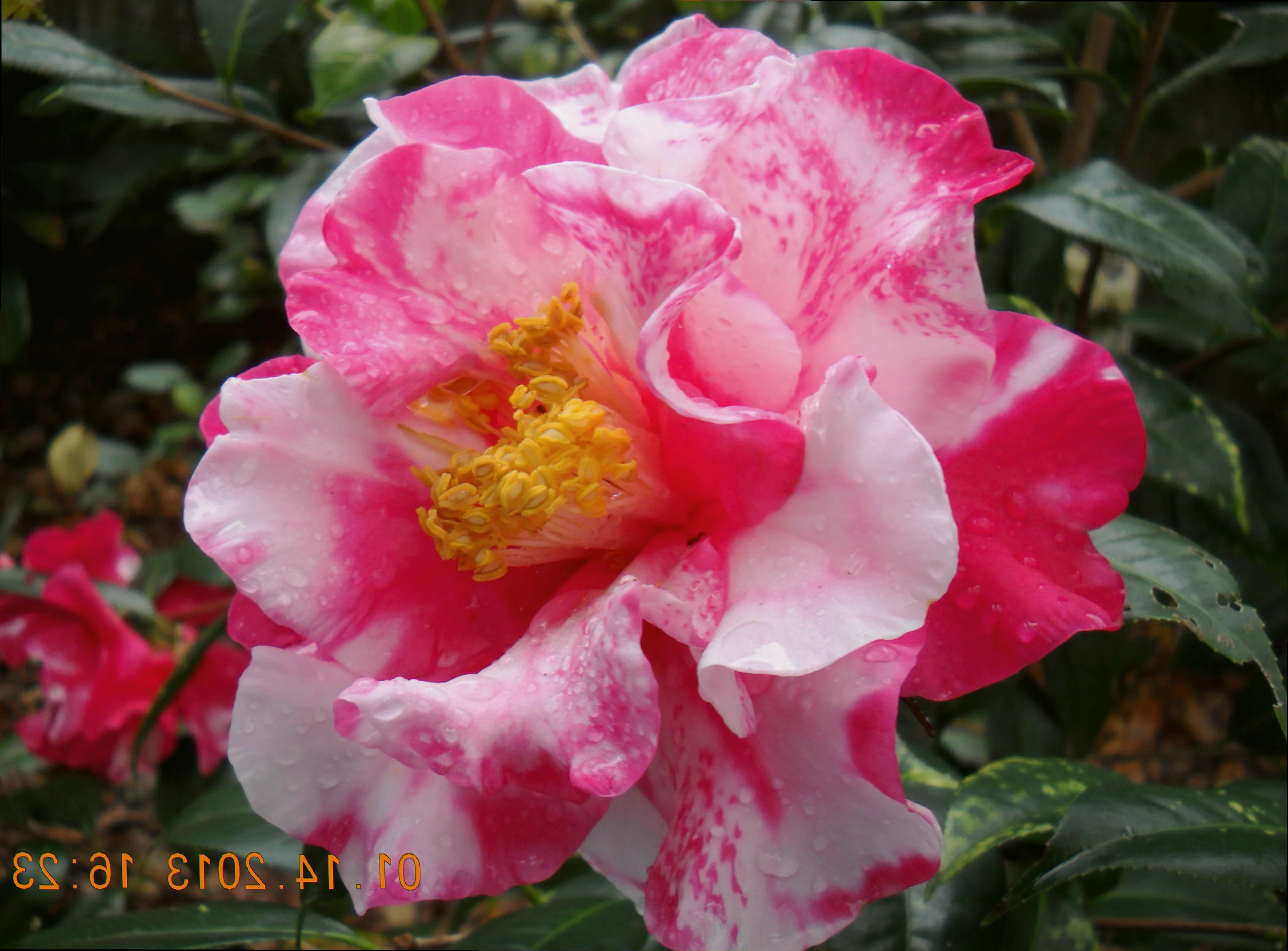
Field impression: The air around a mature specimen of Camellia reticulata 'Frank Houser' hangs heavy with a sweet, almost intoxicating perfume, especially on a cool, damp morning. The sheer volume of its blooms, a riot of ruffled, vibrant pinks, creates an almost overwhelming visual spectacle, drawing the eye and the nose from metres away. Even the gentle rustle of its glossy, dark green foliage in a light breeze seems to carry a subtle, woody scent, a counterpoint to the floral onslaught.
How to Identify Camellia reticulata 'Frank Houser'
| Feature | What to Look For |
|---|---|
| Overall Form | A robust, upright, and often broadly spreading shrub or small tree, typically reaching 3 to 5 metres in height and similar spread. Its growth habit is dense and rounded, especially when well-maintained. |
| Leaf Characteristics | Leaves are evergreen, alternate, simple, and ovate to elliptic in shape. They are typically 7 to 12 cm long and 3 to 5 cm wide, with serrated margins that are finely toothed. The upper surface is a deep, glossy, dark green, while the underside is paler and may have a slight fuzz when young. The petiole (leaf stalk) is short, usually 5 to 10 mm long. |
| Flower Morphology | The defining feature. Flowers are large, double to semi-double, and often imbricate (overlapping petals). They are typically 10 to 15 cm in diameter. The colour is a striking, clear, medium to deep pink, with occasional variations towards a salmon or rose hue, especially in cooler weather. Petals are often ruffled, wavy, or deeply notched, giving a peony-like appearance. The centre may have a few stamens visible amongst the petaloids. Blooms are fragrant, a distinctively sweet and pervasive scent. |
| Buds | Ovoid to globose, often quite large and conspicuous before opening, typically reddish-brown in colour. |
| Bark | Smooth and greyish-brown on younger stems, becoming slightly fissured or rougher with age. |
| Fruit | A woody capsule, typically 2 to 3 cm long, containing several brown seeds. However, in many cultivated settings, especially with hand-pollination, fruits are not reliably produced or are infertile. |
Where and When to Find It
'Frank Houser' is a cultivar of Camellia reticulata, native to Yunnan Province in China. Therefore, finding it 'in the wild' in an Australian context is unlikely, as it is exclusively a cultivated ornamental. However, it thrives in regions with a Mediterranean to temperate climate, experiencing mild, wet winters and warm, dry summers, mirroring its native habitat's conditions. It performs exceptionally well across much of southeastern Australia, including the cool-temperate rainforest fringes of Tasmania, the elevated gardens of the Southern Tablelands of New South Wales (e.g., around Berrima and Bowral), and the established horticultural districts of Victoria (such as the Dandenong Ranges and Macedon Ranges). It is also well-suited to the Adelaide Hills in South Australia and parts of the Western Australian Wheatbelt with adequate rainfall or irrigation. Look for it in established gardens, botanical gardens, and historic estates, typically planted in sheltered positions with dappled shade. The peak flowering season is generally from late winter through spring, with the best months for viewing in Australia being July through to October, depending on local microclimates and the specific year's weather patterns. Early mornings, just after dawn, are often the best time to appreciate the full fragrance of the blooms, before the heat of the day dissipates the scent.
Behaviour Worth Watching
- Unique behaviour 1: The 'petal drop' phenomenon. Unlike many camellias that shed individual petals, mature 'Frank Houser' specimens, when conditions are right (typically after heavy flowering and a slight temperature drop), can shed entire, perfectly formed flowers in a cascade. This isn't a sign of stress but rather a unique method of clearing spent floral material, creating a carpet of intact blooms beneath the plant for a brief period. This is rarely documented outside of dedicated camellia enthusiasts' observations.
- Unique behaviour 2: The subtle 'nodding' of developing buds. In the weeks leading up to flowering, as the large buds swell and begin to show colour, there's a subtle, almost imperceptible downward tilt or 'nodding' of the bud. This is thought to be a mechanism to shed excess rainwater that could otherwise lead to fungal spotting on the developing petals, a crucial adaptation in its native, often humid, environment.
- Social structure: As a solitary cultivated plant, its social structure is dictated by its planting. It is typically found as a singular specimen or in small groups in garden settings. It does not form colonial structures or exhibit cooperative behaviours.
- Defensive display: 'Frank Houser' has no significant defensive displays in the typical sense of an animal. Its defence relies on its robust, leathery foliage which is somewhat resistant to minor browsing by insects. Any perceived threat to the plant itself (e.g., strong winds, heavy rain) is met with structural resilience, with branches bending rather than breaking.
- Activity pattern: Primarily diurnal and photoperiodic for flowering. Its photosynthetic activity occurs during daylight hours. The flowering cycle is strongly influenced by day length and temperature, initiating bud development in autumn and opening in late winter/spring. The release of its potent fragrance is most pronounced during cooler, humid periods of the day, often early morning or late afternoon, to maximise pollinator attraction in its native, less insect-dense, habitat.
Ecological Role in the Australian Landscape
While not a native species, 'Frank Houser' plays a valuable, albeit indirect, ecological role in cultivated Australian landscapes. As a prolific bloomer, it provides a significant early-season nectar and pollen source for a range of native and introduced pollinators, including native bees (e.g., Lasioglossum species), European honeybees (Apis mellifera), and various hoverflies (Syrphidae). The dense foliage offers habitat and shelter for small native birds such as wrens (e.g., Superb Fairy-wren, Malurus cyaneus) and thornbills (e.g., Striated Thornbill, Acanthiza lineata), providing nesting sites and protection from predators. Furthermore, fallen leaves contribute to the organic matter in the soil, improving soil structure and fertility, particularly in garden settings where they might otherwise be removed. In areas with established populations, the occasional self-seeding (though rare for this cultivar) could contribute to local biodiversity by introducing genetic material, though this is a minor effect compared to its primary role as a horticultural specimen.
Lookalikes and How to Tell Them Apart
Camellia reticulata cultivars often share similar characteristics, making precise identification crucial. Several other *Camellia reticulata* cultivars can be confused with 'Frank Houser', particularly those with large, double pink flowers.
- Camellia reticulata 'Captain Rawes': This cultivar is very similar in flower size and form, also producing large, semi-double to double pink blooms. The key difference lies in the petal shape. 'Captain Rawes' often has more cupped or formal petals, with less of the ruffled, wavy appearance of 'Frank Houser'. The colour can also be slightly deeper or more of a salmon-pink.
- Camellia reticulata 'Crimson Glory': While the name suggests red, this cultivar can sometimes present as a deep rose-pink. However, its flowers are typically more formal and less ruffled than 'Frank Houser', often with a more compact, peony-like formation. The colour is generally more intense and less likely to have the salmon undertones seen in some 'Frank Houser' specimens.
Conservation Notes for the Field Naturalist
'Frank Houser' is not a wild species, so its conservation status relates to the preservation of horticultural diversity. The primary threat is the loss of old, established gardens and collections due to urban development and changing land use. While not facing extinction, the genetic lineage of specific, well-established cultivars can be lost if not maintained. Citizen-scientists can contribute by documenting and reporting the locations of significant camellia collections, especially those containing older, heritage cultivars, to local horticultural societies or botanical garden records. Participating in local garden history projects or volunteering for heritage garden maintenance can also help preserve these valuable plants. If you discover an unusually old or vigorous specimen in an overlooked garden, consider photographing it and noting its location for potential documentation.
Common Questions from Observers
What does camellia reticulata 'Frank Houser' eat and how does it hunt?
'Frank Houser' does not 'eat' or 'hunt' in the animal sense. As a plant, it is an autotroph, meaning it produces its own food through photosynthesis. It absorbs water and essential mineral nutrients from the soil through its root system. Carbon dioxide is taken from the atmosphere through its leaves, and sunlight provides the energy for photosynthesis. Its 'hunting' behaviour is entirely passive; it relies on its root system to acquire resources from the soil and its leaves to capture sunlight and carbon dioxide.
Is camellia reticulata 'Frank Houser' nocturnal?
No, Camellia reticulata 'Frank Houser' is not nocturnal. It is a diurnal plant, meaning its primary biological processes, particularly photosynthesis, occur during daylight hours. While its flowers may release their strongest fragrance in the cooler, humid conditions of early morning or late afternoon, this is an adaptation for pollinator attraction rather than a reflection of nocturnal activity. The plant itself is metabolically active throughout the day, converting light energy into chemical energy.
Can camellia reticulata 'Frank Houser' be found in suburban gardens?
Yes, Camellia reticulata 'Frank Houser' is very commonly found in suburban gardens, particularly in regions with suitable climates. It was a popular choice for garden designers and homeowners throughout the mid to late 20th century and continues to be appreciated for its spectacular blooms. Many older suburban properties across Australia, especially those with established gardens, will feature mature specimens of 'Frank Houser'. Its adaptability to well-drained soils and partial shade makes it a relatively straightforward plant to grow in a domestic setting, provided it receives adequate moisture and protection from harsh winds and extreme frost when very young.